Foundation Models of Matter
Scientific Models Grounded in Fundamentals
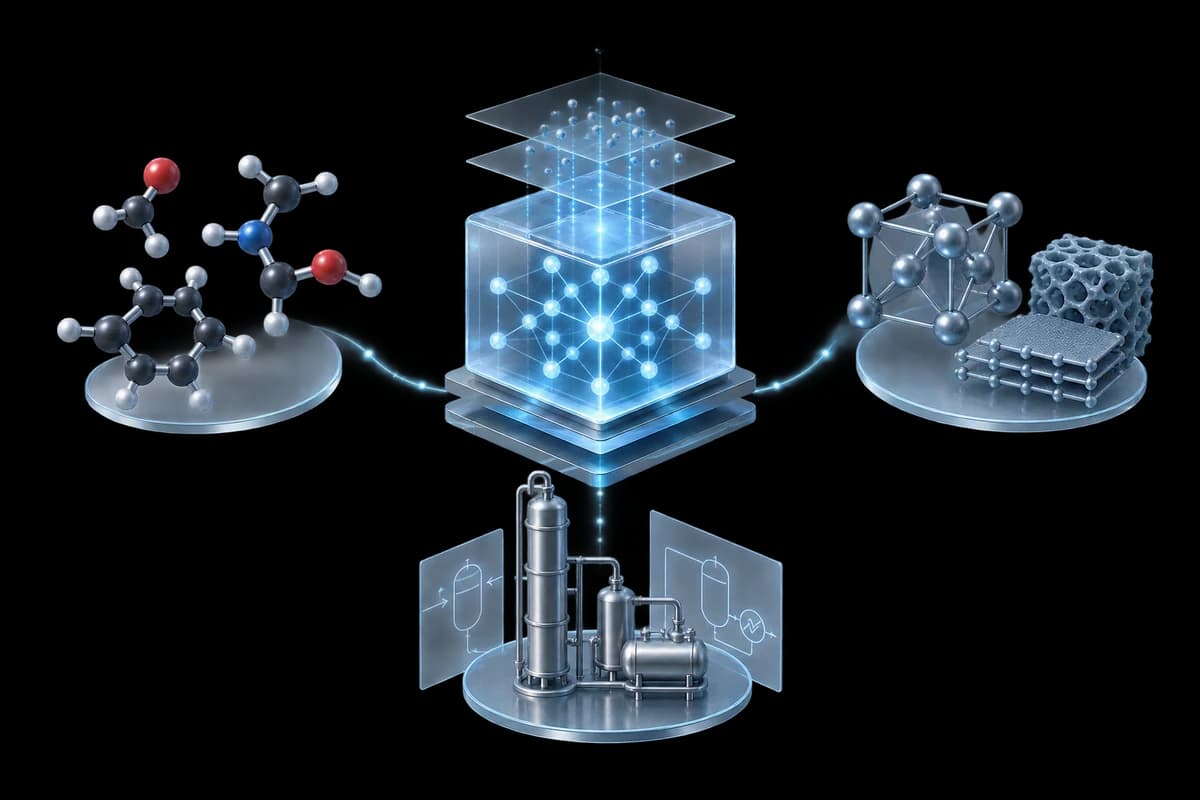
Multimodal foundation models that reason across molecules, reactions, formulations, processes, and outcomes, not generic AI with a science wrapper.
Model Capabilities
A family of multimodal scientific foundation models purpose-built for chemical, materials, and process R&D.
Molecular Structure Understanding
Native reasoning over molecular graphs, SMILES, InChI, and 3D conformations. Models that understand chemistry at the structural level.
Reaction Graph Reasoning
Predict outcomes, optimize conditions, and plan synthetic routes by reasoning over reaction networks and transformation patterns.
Formulation Modeling
Understand ingredient interactions, predict mixture properties, and optimize formulations across performance and manufacturing constraints.
Spectra and Imaging Analysis
Interpret NMR, IR, mass spectra, chromatograms, microscopy, and other instrument data with domain-native multimodal models.
Process Time Series Reasoning
Analyze reactor data, process historian logs, and manufacturing time series to detect patterns, anomalies, and optimization opportunities.
Multi-Objective Optimization
Optimize across performance, cost, safety, manufacturability, and more simultaneously. Real-world constraints, not single-metric benchmarks.
Constraint-Aware Generation
Generate candidates that respect physical, chemical, regulatory, and economic constraints from the start. Not filter-after-the-fact.
Physics and Chemistry Priors
Models informed by thermodynamic laws, reaction mechanisms, and physical constraints. Domain priors improve accuracy and reduce data hunger.
Real-World Optimization Axes
Single-metric optimization produces lab curiosities, not products. Alchemic models optimize for the real world across ten default axes.
What Our Models Help You Do
Decision-ready predictions that connect design to performance and manufacturability.
Search chemical design spaces
Navigate vast molecular, materials, and formulation spaces with intelligent search guided by domain priors and experimental evidence.
Generate candidate molecules, materials, catalysts, routes, and formulations
Produce diverse, high-quality candidates that satisfy target profiles. Not random sampling, but constraint-aware, objective-driven generation.
Optimize across multiple objectives simultaneously
Balance competing demands like performance versus cost, stability versus reactivity, or throughput versus purity in a single optimization run.
Forecast risk before running experiments
Predict failure modes, assess scale-up risk, and estimate experimental uncertainty before committing resources to the bench or pilot plant.
Connect structure to performance and manufacturability
Bridge the gap between molecular or material design and real-world manufacturing. Predictions that survive contact with the plant.
“Our models extend the reach of chemists, materials scientists, and process engineers; they don’t replace them.”
Better option quality. Reduced blind search. Reusable prior knowledge. Improved experimental efficiency. The scientist stays in command.
See what the models can do for your team
Explore how foundation models of matter can accelerate your discovery, formulation, and process workflows.