Batteries & Energy Materials
Design electrolytes and electrode materials, optimize cycle life, balance safety against performance, and factor supply chain realities into every decision. Alchemic brings constraint-aware intelligence to energy materials development.
Key Workflows
Energy materials development requires navigating complex tradeoffs across performance, safety, cost, and supply risk. Alchemic makes these tradeoffs quantitative and actionable.
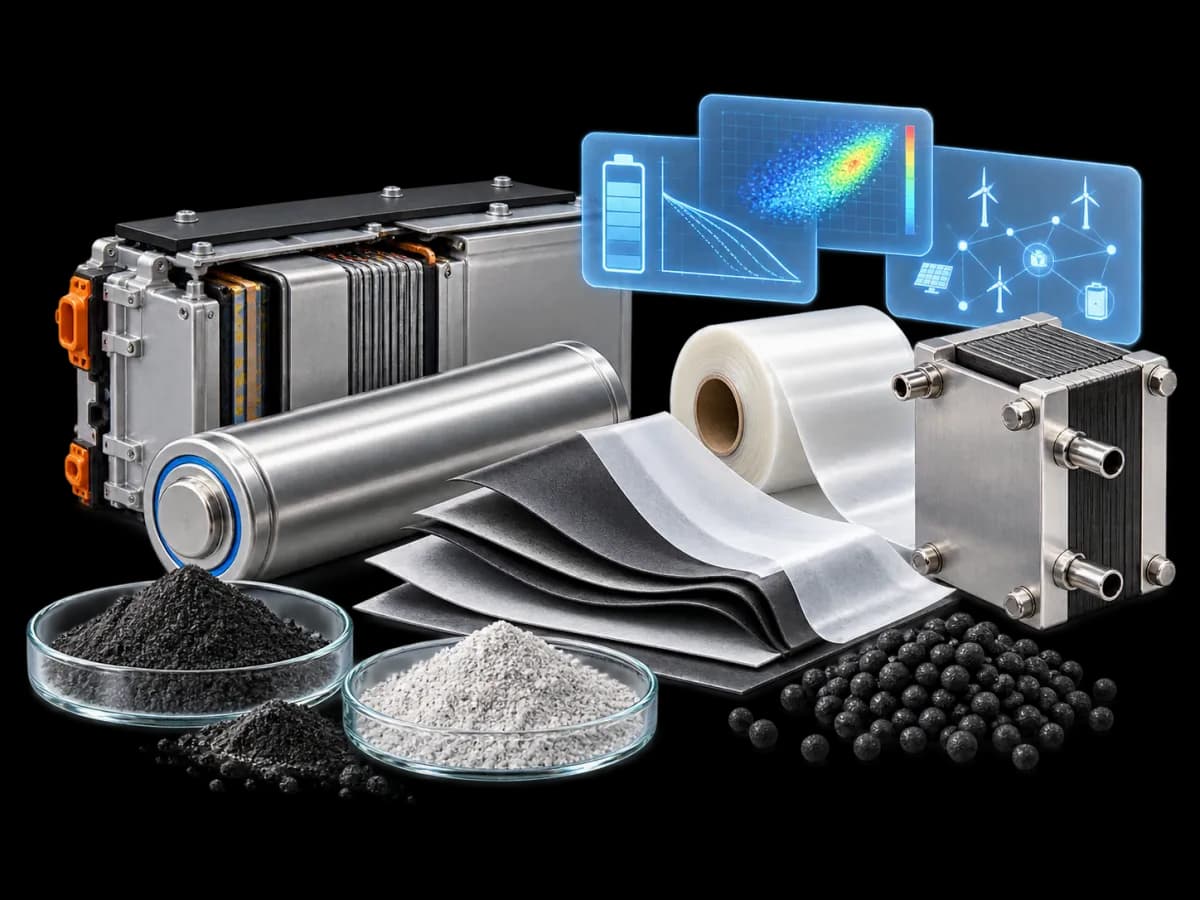
Electrolyte Formulation
Design electrolyte systems that balance ionic conductivity, electrochemical stability, safety, and cost. Alchemic generates candidate formulations, predicts key properties, and prioritizes experiments to validate the most promising compositions.
Electrode Material Design
Explore compositional and structural design spaces for cathode, anode, and solid-state materials. Foundation models connect crystal structure, synthesis conditions, and electrochemical performance to guide candidate selection.
Cycle Life Optimization
Predict and extend cycle life by identifying degradation mechanisms early. Alchemic integrates accelerated aging data, impedance measurements, and post-mortem analysis to build predictive models that reduce long-duration testing requirements.
Safety-Performance Tradeoffs
Navigate the tension between energy density, power density, thermal stability, and safety margins. Alchemic makes these tradeoffs explicit and quantitative, enabling teams to make informed decisions against application-specific requirements.
Supply Chain Risk Analysis
Assess raw material availability, sourcing concentration, cost volatility, and geopolitical risk for candidate chemistries. Factor supply chain realities into material selection decisions before committing to scale-up.
How Alchemic Helps
Battery and energy materials teams need to move fast while managing extraordinary complexity. Alchemic provides the infrastructure to reason across materials, cells, and systems.
Multimodal Materials Data
Ingest and unify electrochemical cycling data, spectroscopy, diffraction, microscopy, computational results, and literature into a single evidence layer with full traceability.
Physics-Informed Models
Foundation models incorporate electrochemical constraints, thermodynamic priors, and transport physics to produce predictions that respect the underlying science.
Multi-Objective Optimization
Optimize simultaneously across energy density, power, safety, lifetime, cost, and manufacturability. See the full Pareto frontier, not just single-objective rankings.
Program Tracking
Track design campaigns from initial screening through cell testing and qualification. Maintain project memory so that insights compound across teams and programs.
Inside a campaign: Electrolyte additive screen
Extend cycle life without giving up rate or safety.
A cell team wants more cycles out of an existing Li-ion chemistry, but cannot lose rate capability or expand the safety envelope. Additive options run into the thousands; bench bandwidth runs into the dozens.
- Step 01 · Input
Anchor the chemistry
Cell architecture, baseline electrolyte, lifetime target, rate-capability floor, and hard safety constraints are entered along with relevant internal cycling data.
- Step 02 · Generation
Generate additives
Foundation models propose ~150 candidate additives, pre-filtered for solubility, electrochemical window, and supplier availability. Each carries an evidence trail.
- Step 03 · Tradeoffs
Stack-rank tradeoffs
22 candidates dominate the baseline on cycle-life proxies. 8 of those also clear the hazard model. Two outliers are flagged for elevated flammability risk.
- Step 04 · Plan
Plan the experiments
Top 5 enter coin-cell trials. The agent stages a small A/B sub-campaign for the two outliers so the safety question gets answered before they reach pouch cells.
Outcome: Instead of a year-long screen, the team starts cell builds with a defensible shortlist, an explicit safety check on the riskier candidates, and a closed loop that gets sharper after every batch of cycling data.
Accelerate your energy materials programs
See how Alchemic helps battery and energy materials teams design, test, and scale better materials faster.